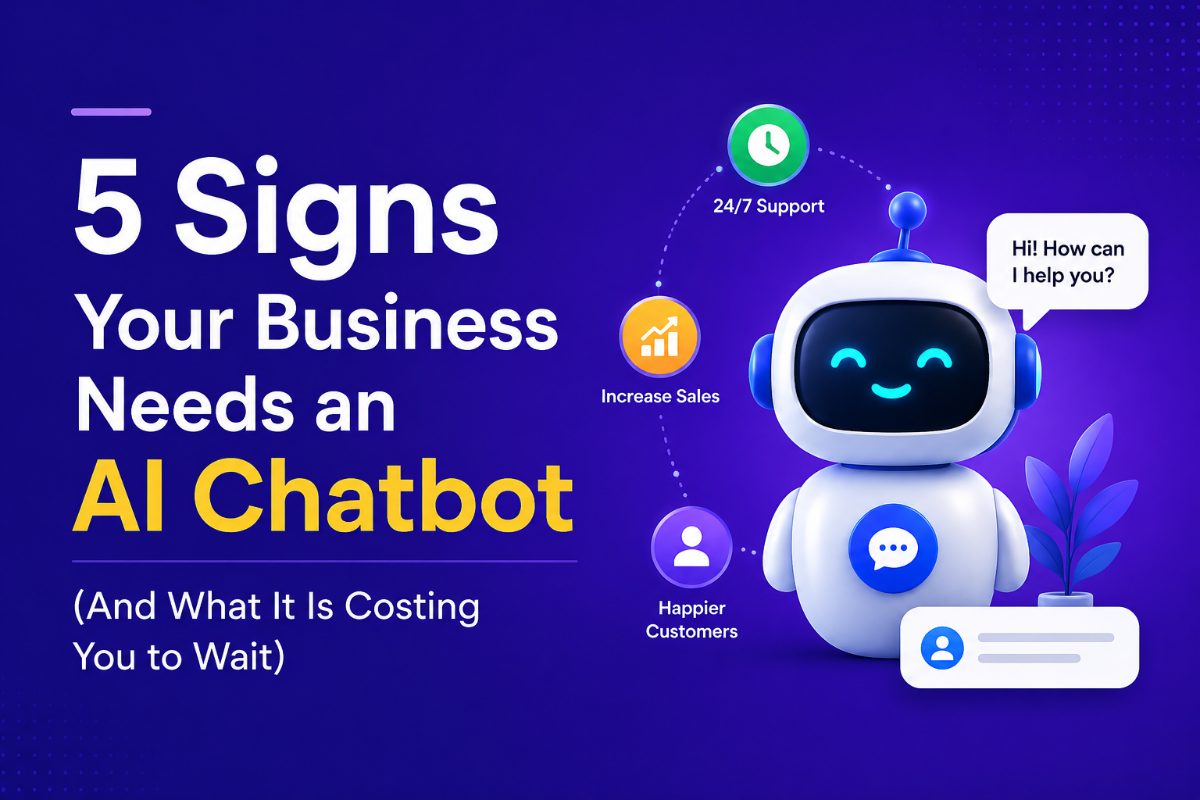
The Hidden Cost of Waiting
Here is a number most business owners do not know: up to 82% of customers expect an immediate response when they have a sales or support question.
"Immediate" means within 10 minutes or less. For most businesses without a chatbot, that is simply impossible.
The result is not just frustrated customers — it is lost revenue that never shows up on any report. You never see the leads that bounced because nobody answered. You never count the sales that went to a competitor who replied faster.
If you have been wondering whether your business needs an AI chatbot, the question is probably already answered. Here are five signs to confirm it.
Sign 1: You Are Answering the Same Questions Over and Over
Open your email inbox right now. How many of the last 20 messages contain some version of these questions?
- "What is included in the pricing plan?"
- "How do I get started?"
- "Do you offer a free trial?"
- "How does [feature] work?"
- "What is your return policy?"
If your answer is "most of them," you are spending a significant chunk of your week on questions that never change — and that a chatbot could answer instantly, automatically, without your involvement.
What this is costing you: Time that should go toward growing your business is going toward repetitive communication. And every hour you spend in your inbox is an hour a competitor is spending on strategy, product, or sales.
Sign 2: You Miss Inquiries Outside Business Hours
Your website does not close at 5 PM. Visitors browse it in the evenings, during lunch breaks, on weekends, and on holidays.
If you have no automated response system, every inquiry that comes in outside of business hours sits unanswered — sometimes for 12 to 24 hours or more.
By the time you reply, the prospect has often already made a decision. Research from Harvard Business Review found that leads contacted within an hour are 7 times more likely to convert than those contacted even an hour later.
What this is costing you: A meaningful percentage of your inbound leads — specifically the ones who inquire after hours — are converting for competitors who have a chatbot ready to respond immediately.
Sign 3: Your Support Volume Is Overwhelming Your Team
There is a particular kind of busy that feels productive but is not. It is when your team is constantly in reactive mode — answering tickets, responding to emails, handling chats — with no bandwidth left for proactive work.
If your support team feels this way, it is a sign that a large portion of their workload could be automated. Most support teams find that 60-80% of incoming inquiries are variations of the same common questions — exactly what a well-trained AI chatbot handles best.
What this is costing you: Burnout, slower response times, higher error rates, and the inability to scale support without proportionally scaling headcount.
Sign 4: Your Website Has Traffic But Poor Conversion
If your analytics show healthy visitor numbers but your leads or signups are not matching that traffic, the gap is often information.
Visitors arrive with questions. If those questions go unanswered — because nobody is there to answer them and the FAQ page is buried three clicks deep — they leave.
A chatbot proactively engages visitors, surfaces relevant information, answers objections in real time, and guides people toward the action you want them to take. It is the difference between a passive brochure website and an active sales tool.
What this is costing you: Your highest-traffic pages are bleeding potential customers who leave without converting because their questions were never answered.
Sign 5: You Are Trying to Scale Without Scaling Your Team
There comes a point in every growing business where the math stops working: you cannot keep adding headcount at the same rate you are adding customers.
AI chatbots break that constraint. They handle volume that would require multiple additional hires — and they do it at a fraction of the cost, with no hiring timeline, no training period, and no turnover risk.
If you are in a growth phase and thinking about how to scale support efficiently, an AI chatbot is almost always part of the answer.
What this is costing you: Scaling without automation creates a ceiling. Eventually, the bottleneck is human capacity — and human capacity is slow and expensive to expand.
How Much Is Waiting Actually Costing?
Let us put rough numbers on this.
If your business generates 100 inbound inquiries per month and a chatbot could handle 70 of them automatically, you are freeing up roughly 70 conversations' worth of time from your team.
If just 10% of the after-hours inquiries you are currently missing would have converted — and your average customer value is $200 — that is $2,000 per month in recoverable revenue for a business with 100 monthly inquiries.
For most businesses, the ROI calculation is not close. The chatbot pays for itself quickly.
What to Do Next
If two or more of these signs apply to your business, the conversation about whether to get a chatbot is over. The conversation now is about which chatbot, and how quickly you can get it live.
Pixy AI is built for businesses that want to move fast. You can have a fully trained, branded chatbot live on your website in under 10 minutes — no developers, no long implementation, no waiting.
Frequently Asked Questions
How much does a business chatbot cost?
Pixy AI offers plans starting at an accessible monthly rate, with a free tier to get started. The cost is almost always less than a single additional support hire.
What types of businesses benefit most from AI chatbots?
Any business that receives repetitive customer inquiries benefits. E-commerce, SaaS, service businesses, agencies, healthcare practices, and education companies are among the most common use cases.
Can a chatbot really replace part of my support team?
It can replace the repetitive portion of their work — typically 60-80% of common inquiries — freeing your team for complex, high-value conversations that genuinely need human attention.